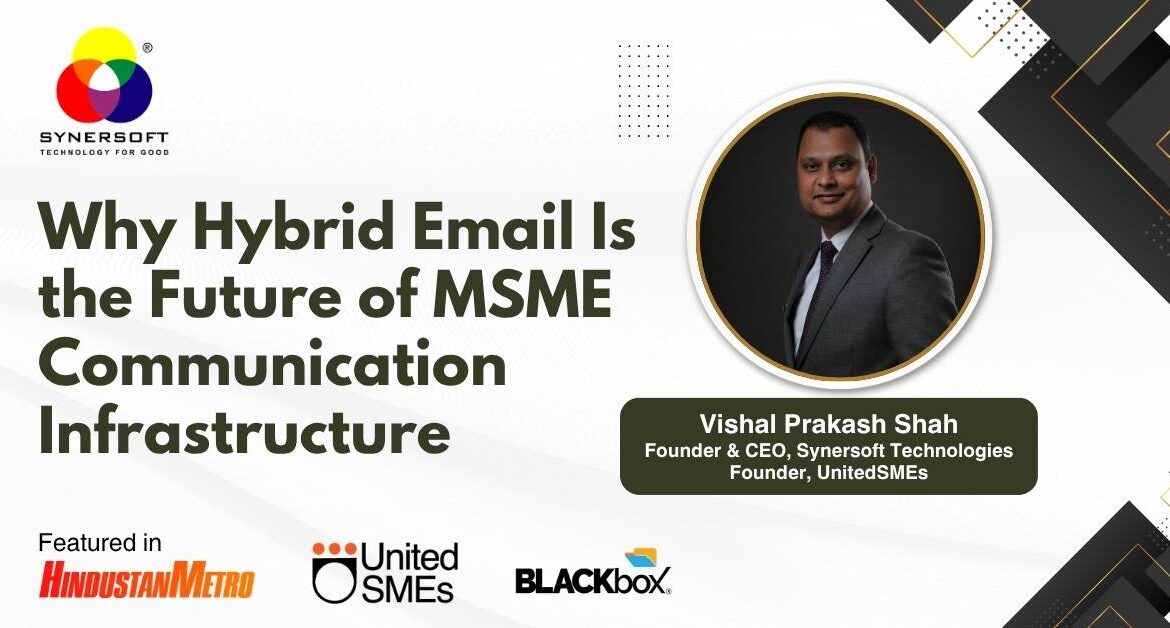
Vishal Prakash Shah on Why Hybrid Email Is the Future of MSME Communication Infrastructure

In an interaction with Hindustan Metro, Mr. Vishal Prakash Shah, Founder and CEO of Synersoft Technologies Pvt. Ltd., shares a compelling perspective on how hybrid email architectures are redefining digital communication for MSMEs. Drawing from deep insights into cost structures, security priorities, and scalability challenges faced by growing enterprises, Shah explains how Synersoft’s hybrid email model bridges the long-standing gap between cloud-only and on-premise systems. His views highlight a pragmatic, future-ready approach that aligns technology with real usage patterns, economic sustainability, and the evolving needs of businesses in India and emerging markets.

1. What specific limitations of traditional cloud-only or on-premise email systems did you aim to solve with Synersoft’s hybrid email architecture?

Ans. Traditional email models forced MSMEs into binary choices. Cloud-only systems offered convenience but imposed uniform licensing costs and long-term vendor dependency, while on-premise systems required higher upfront investment and in-house IT expertise. Most MSMEs did not fit neatly into either model.

Our hybrid email architecture was designed to bridge this gap. It allows organizations to selectively use premium cloud services where they genuinely add value, while providing a cost-efficient, secure email system for the majority of users; without compromising domain identity, reliability, or control. The objective was to align email infrastructure with actual usage patterns rather than forcing businesses into rigid, one-size-fits-all frameworks.

2. How does your hybrid email model redefine cost efficiency for MSMEs compared to standard per-user enterprise email pricing structures?

Ans. Enterprise email platforms price every user at the same level, regardless of usage intensity. In reality, only a small percentage of users require advanced collaboration features and large cloud storage.

The hybrid model breaks this uniform pricing logic. By allocating premium cloud licenses only to critical roles and shifting other users to a pooled, enterprise-grade email system, MSMEs can reduce annual email expenditure by 50–70%. This cost efficiency is structural, not discount-driven. It is achieved through architecture, not negotiation, making it sustainable even as organizations scale.
3. In what ways does the hybrid system maintain enterprise-grade security and compliance while offering greater architectural flexibility to MSMEs?

Ans. Security and compliance were foundational to the design. Hybrid email does not dilute security; in many cases, it enhances it.

The platform incorporates layered controls such as spam and malware filtering, SMTP security, audit logs, policy-based monitoring, and data flow controls. For MSMEs operating under NDAs, audits, or vendor compliance requirements, this architecture supports disciplined information handling while offering visibility and governance.

Importantly, the flexibility lies in deployment and cost structure; not in compromising security posture.

4. How does Synersoft’s hybrid email platform enable MSMEs to scale seamlessly as their collaboration and communication needs evolve?

Ans. The hybrid model is inherently modular. As organizations grow, roles evolve, or collaboration needs increase, users can be selectively upgraded to premium cloud services without restructuring the entire email environment.

This avoids disruptive migrations and repeated domain changes. MSMEs gain the ability to scale incrementally; adding advanced tools only where required; while keeping operational email stable for the rest of the organization. It allows technology to grow with the business, not ahead of it.

5. What role does partner-led deployment play in the success of the hybrid email system, and how does it differ from vendor-driven cloud rollouts?

Ans. Partner-led deployment is central to adoption success. Unlike vendor-driven rollouts that prioritize standardization, partners understand the customer’s operational context, compliance needs, and cost sensitivities.

This approach enables customization, phased implementation, and ongoing support; turning email infrastructure into a managed service rather than a subscription sale. It also allows IT partners to retain customer ownership, build annuity-based relationships, and act as long-term advisors rather than resellers.

6. Looking ahead, how do you see hybrid email architectures shaping the future of digital communication infrastructure for MSMEs in India and emerging markets?

Ans. Hybrid email represents a broader shift toward selective digitization and architectural independence. MSMEs are becoming more conscious of cost sustainability, data control, and vendor risk.

In India and other emerging markets, hybrid architectures will become the norm; balancing cloud convenience with economic prudence and operational control. Over time, they will form the foundation for resilient, compliance-ready digital communication frameworks that grow with the business rather than constrain it.

Related Posts

24

Apr
HR Training, SMEs of India, Social Media Optimization, United SMEs

The Technology Shift Behind 70% Cost Savings in Enterprise Email Infrastructure

By Vishal Prakash Shah, Founder & CEO, Synersoft Technologies: For more than a decade, enterprise email infrastructure has largely followed a single trajectory: move everything to the cloud. Platforms such as Google Workspace and Microsoft 365 became synonymous with reliability, collaboration, and ease of management. For many organizations, especially during the early stages of digitization, this approach made [...]

20

Mar
HR Training, SMEs of India, Social Media Optimization, United SMEs

The Evolution of Enterprise Email from Subscription Software to Infrastructure Strategy

Vishal Prakash Shah, Founder & CEO, Synersoft Technologies For many organizations, email has quietly become one of the most expensive pieces of digital infrastructure. What once appeared to be an inexpensive productivity tool has gradually transformed into a recurring operational expense that grows with every new employee added to the system. The rise of enterprise cloud platforms such[...]